Showing posts with label exhibition. Show all posts

Friday, 23 October 2009

Sacred made Real

A retrospective of some of the most realistic religious art to be produced in 17th century Spain, “The Sacred Made Real” presented at the National Gallery, is the result of 10 years of work giving art lovers the chance to see masterpieces rarely seen outside of Spain, including work by Velázquez and Zurbaran, as well as other artists involved in the Counter Reformation. Most pieces are still paraded through the streets of Spain during the Easter processions.
This is the first major exhibition to explore the relationship between sculpture and painting during the Spanish Golden Age, taking a closer look at the ways in which artists combined their skills to bring their religious subjects back to life with arrestingly real depictions designed to inspire feelings of awe and to make viewer feel the presence of Christ.

Dramatically lit against dark grey walls, the marvelous and often disturbing exhibition spares its audience nothing – gaping wounds, rivers of blood, severed heads, ruined flesh, Christ's tortures, excruciations and morbid miseries.


“Dead Christ”, Gregorio Fernandez, 1625-1630


The first image visitors confront is the "Head of Saint John the Baptist", an impressively realistic severed head, complete with detailed rendition of the anatomy of a neck by master carver Juan de Mesa. According to Curator Xavier Bray the artist may well have used a real severed head as a model, "as a lot of people were decapitated in those days."

“Head of Saint John the Baptist”, Juan de Mesa

Sculptures from this era were painstakingly carved from wood, gessoed and intricately polychromed, many of them by Francisco Pacheco, who taught a generation of painters, including Velázquez and Cano.
Some artists used glass eyes, stained ivory for the teeth, tears made of glass and ox-horn fingernails in their work to achieve the most life like effects, reflecting a certain macabre ingenuity.
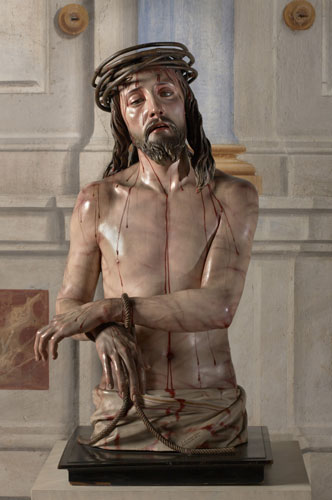
“Christ as the Man of Sorrows", Pedro de Mena, 1673

“Christ as the Man of Sorrows" (detail), Pedro de Mena, 1673
Intended to be seen from a close up, the skill with which this carving has been panting is exceptional. Blue paint has been applied beneath the flesh tones in order to suggest the bruising of Christ's skin. The rivulets of blood which trickle down his body are soaked up by the loincloth. Glass eyes have been inserted and real hair use for the eyelashes.
The sculptures were artists' response to a challenge laid down by Dominican, Carthusian and Franciscan orders who wanted to bring the sacred to life, in order to shock the senses of the faithful and strengthen their devotion.
“Dead Christ” (detail), Gregorio Fernandez, 1625-1630

“Dead Christ” (detail), Gregorio Fernandez, 1625-1630
Gregorio Fernandez's “Dead Christ” uses cork bark to simulate congealed blood and bull’s horn for Christ’s fingernails. His corpse has not yet been washed and prepared for burial; blood still oozes from the wonds.
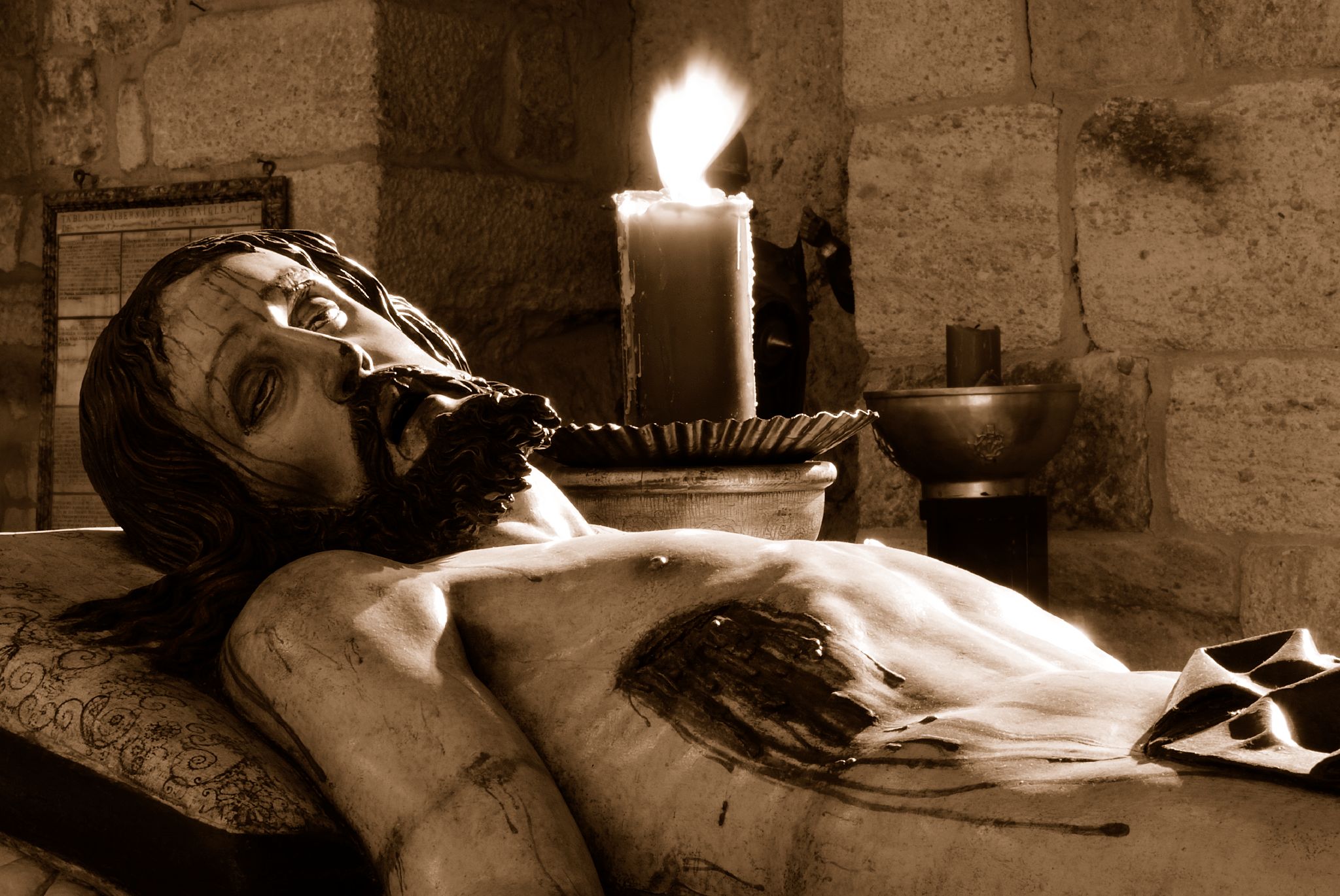
“Dead Christ”, in situ, Church of Santa Maria de la Nueva,Valladolid.


"The Virgin of Sorrows" (detail), Pedro di Mena, about 1673
Painted wood, ivory, glass and human hair.

For those interested in finding out more about how the 17th century artists created their polychrome sculptures, “The Sacred Made Real” is accompanied by a free exhibition running alongside the main display.

Tuesday, 20 October 2009

Sacred Made Real

Tomorrow I am going to see “The Sacred Made Real”, a retrospective of the most realistic religious art to be produced in 17th century Spain, presented at the National Gallery.

It will be a remarkable chance to see masterpieces rarely seen outside of Spain, including work by Velázquez and Zurbaran as well as arrestingly real depictions such as Gregorio Fernandez 's "Dead Christ” only to quote one.
“Dead Christ”, Gregorio Fernandez, 1625-1630

Telling Tales: Fantasy and Fear in Contemporary Design at the V&A

"Telling Tales" explores the recent trend for unique or limited edition pieces, inspired by the spirit of story-telling, that push the limits between art and design.

“Design art” are products that transcend the boundaries between function and art. Function is not of primary importance anymore, artistry in the details takes over whilst familiar domestic items are invested with strange properties.

In the first room, entitled “The Forest Glade”, subtle sounds of creaking forest incite the visitor to become attentive to the natural possibilities of beauty and danger.
'Fig Leaf' armoire by Dutch designer Tord Boontje is at once a place to hang clothes and an artifact of insane beauty, with its 616 leaves enameled by hand.
“Else” by Julia Lohmann is a bench in the shape of a decapitated cow covered in blood-burgundy leather.
'Bathboat' by Wieki Somers
The 'Bathboat' is like a small boat turned inside out, designed to keep water in rather than keep it out, making the connection between floating on the water and bathing in the water because they evoke many similar feelings and elements.
'Petit Jardin' chair by Tord Boontje celebrates nature's fecundity and is constructed entirely from stylised plant fronds. However the verdant growth threatens to engulf or impale the sitter, giving a sinister undertone to the chair's decorative appearance.
'Linen-Cupboard-House' by Jurgen Bey.
Just as children imaginatively build fortresses, so Jurgen Bey used old furniture to create this guest room. It is like the gingerbread house in the classic fairy story, where Hansel and Gretel were promised sanctuary but were deceived by the witch.
'Sculpt' wardrobe by Maarten Baas pretends to be made from rough-hewn wood, but despite its appearance, the wardrobe is not carved from a single massive tree trunk, but was made from sheet steel that has been veneered.

Out of the woods and into the “Enchanted Castle” section, symbols of wealth and status are prodded and parodied.
The "Robber Baron" collection by Belgian design duo Studio Job includes a black cast bronze and gilded jewel safe topped with the head of a clown and a table crafted in the shape of golden smoke rising from four factory chimneys.
"Robber Baron" table by Studio Job.

The exhibition ends with the gloomy rooms of the "Heaven and Hell" section where visitors have to peer through windows to distinguish the sinister items designed to remind them of their own mortality.
Fredrikson Stallard’s red, urethane-rubber rug intends to represent the exact amount of blood in two people.
Heaven and Hell section.
"Sensory Deprivation Skull" by Joep van Lieshout.
'Damned.MGX' chandelier by Luc Merx.
The tumbling bodies that make up this chandelier were inspired by Rubens's depiction of the Fall of the Damned at the moment of God's last judgement.
Kelly McCallum's stuffed fox, "Do You Hear What I Hear" has gold-plated maggots squirming from its dead, dry ears.

In design as well as fairytales, things are not always what they seem and designers featured in this show will most certainly give you nightmares instead of happy endings!

Sunday, 6 September 2009

When Magritte meets Beuys...

Typically, I forgot to mention one the installation I liked the most when visiting “Walking in my Mind” at the Hayward Gallery yesterday.

"The first cut is the deepest and the division of seven", 2009
Bo Christian Larsson's themes are mysterious and esoteric and he first stroke me as being the Magritte of walk-through mindscapes. All his works – drawings, installations, performances and objects – interrelate; environments and objects are created for a spontaneous performance and, after this action has taken place, continue to inhabit the space, like archaeological remains.
I would actually go even further by placing Larsson as a cross between Magritte and Beuys althought as far as I am aware Larsoon has yet to work with coyotes!


The Worldhaters Homesick Blues Original, 2009

“La Lunette d'Approche", René Magritte, 1963

"Information has to enter your mind and become part of you before you can process it and use it in a creative way, so naturally everything comes from inside. I would say that my work shows my creative process in its naked truth. I see no difference between the finished work and the process."


The Worldhater's Sculpture Garden
Almost all of Larsson's installations are the results of a performance or happening. The essential elements and structures in the installations are prepared and specified, and the performance is an act of spontaneous action within this controlled space. A recurring component is a black wig hiding Larsson's face, creating a sort of artificial blindness and darkness guiding the view to the inside, to the essential.
"The Worldhater's Sculpture Garden" during the performance.
For Larsson everything has its origin in the darkness, where the human spirit develops - and in this case, free from the apparent reality because of the reduced visual perception: "I think this [the wig] is the only costume you can wear at all, it makes so little and so much with your body at the same time.[...]. You put on the wig and you are a different person. This has always fascinated me. I have the wig in front of my eyes. I turn it around, so I can't see anything. This is a very important point in my performances, that I blind myself and have to take a look inside. I become a different person and disappear in this role."


"The Golden Cage A.K.A. Dieisland" during the performance...


...and after the performance, with Larsson's white shirt hanging in the middle and a speaker to narrate the story.

Saturday, 5 September 2009

Walking in my mind

[info]vampyresheep and I went to the see "Walking in my mind" at the Hayward Gallery this evening just on time before the closure this weekend. The blurb said that the exhibition is "an expedition into the mysterious mental processes of creativity" and we were certainly not disappointed!

"Walking in my mind" is a series of walk-through mindscape drawn from Freud's structural model of the psyche, id, ego and super-ego.

The ten artists in the show are creative about their own creating, each having made a psychic self-portrait in the form of a stroll-through installation.


"The Creation Myth" by Jason Rhoades


Jason Rhoades's sprawling, rambunctious installation in which a huge, red inflatable tube represents the alimentary system, leads to the engine room of the brain, a control centre flickering with computers and televisions. Rhoades uncovers the process of the mental handling of images, impressions and impulses asking himself why one thing is being stored in the brains and the other not as well as what role do moral principles play in this. Yet Rhoades's "Creation Myth" could represent any mind were it not for the hardcore porn scattered all around the room and scatological humour.
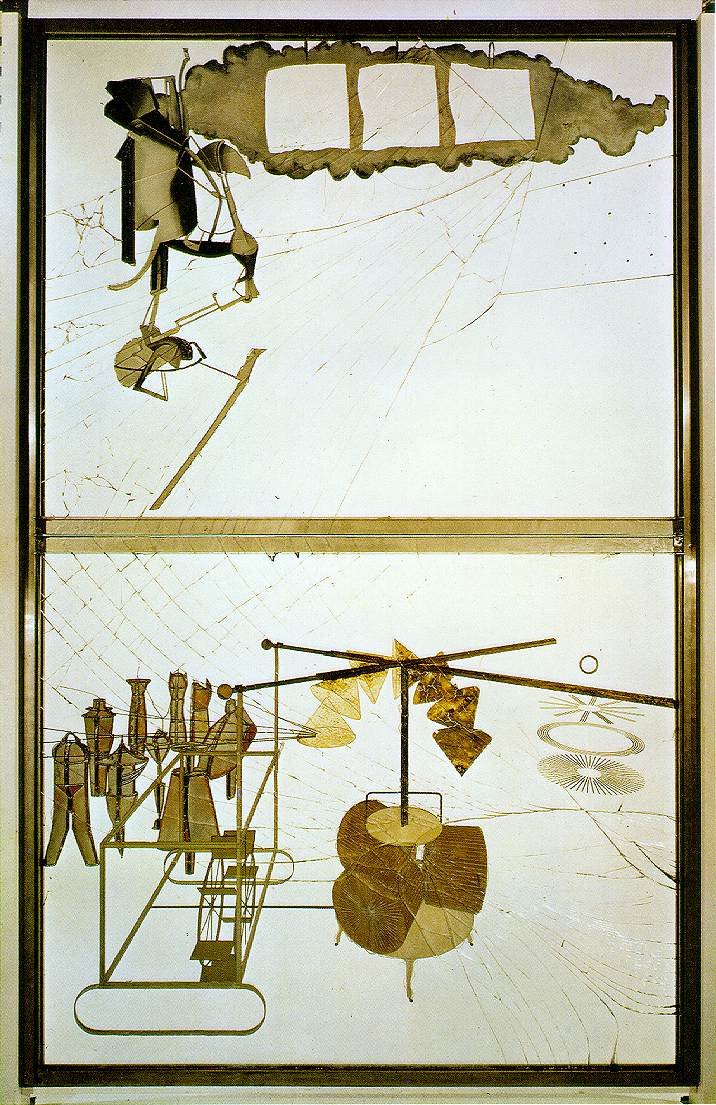
The art-historical roots of Jason Rhoades can be found in the work of Marcel Duchamp, the most obvious reference springing to my mind being his "Bride Stripped Bare By Her Bachelors" but also in the Fluxus movement and in the radical statements of Minimal Art from the sixties.


"The Bride Stripped Bare by Her Bachelors, Even" (The Large Glass), 1915-23.
Oil, varnish, lead foil, lead wire, and dust on two glass panels.


Charles Avery takes the walking bit of the show's title literally as one part of his installation is downstairs, another upstairs and a third one is out on a terrace.

Untitled, (Bejewelled Hare), by Charles Avery, 2009
Untitled (Eternity Chamber), by Charles Avery, 2007

Untitled (Distance at a Distance) by Charles Avery - 2009

Swiss artist Thomas Hirschhorn created a walk-through cranium, constructed from packing tape and cardboard, silted with used Coke cans and outsize philosophy texts. The slippery passageways are flyposted with Marxist tracts, there are shadowy silver figures - Plato's cave - and the caves of Lascaux are shown on shadowy monitors.


Cavemanman by Thomas Hirschhorn

In this exhibition it is not the ponderously thought-through works that stays with you, but the uncanny simplicity of three artists, all Japanese.
In Yoshimoto Nara's case, looking through the windows of his comic-filled Wendy house, My Drawing Room, is to feel a common mourning of childhood.

My Drawing Room by Yoshimoto Nara


Yayoi Kusama now 80, has lived for years as a voluntary in-patient at a Tokyo mental hospital. Her famously polka-dotted soft sculptures are drawn from hallucinations she suffered as a child when she would see dots both inside and outside her head. In this show Kusama's room filled with spotty inflatables, co-opts you as a character in a fairy tale, or perhaps as a fifth Teletubby or as Tintin in "L'Étoile mystérieuse".

Yayoi Kusama, “Dots Obsession"
"Les Aventures de Tintin: L'Étoile mystérieuse"

Kusama's dots spread contagiously over every inch of an entire room before spilling out on the balcony and even on a few the trees on the South Bank.


It is the least known of the three Japanese artists who really impresses. Chiharu Shiota has filled a section of the Hayward's top floor with a tunnel of stretched black threads, imprisoning white spectral shapes.

After the Dream by Chiharu Shiota

After the Dream by Chiharu Shiota (detail)

I guess I can only strongly encourage you to visit the exhibition and will conclude this review by quoting Chiharu Shiota, "When I dream... I feel the dream as reality. I can't distinguish between dream and reality. When I wake up, I have the feeling I'm still dreaming."

Saturday, 22 August 2009

Exquisite Bodies

I had such a tough day at work on Thursday having to look at all those models coming in the office for our new advertisement campaign... Very luckily this happens once a year only! ^-^’


After all those emotions I had lunch with [info]morbidfrog and had aprivate tour of her library!
Our new lunchtime picnic spot ^^'

After work, [info]morbidfrog, [info]vampyresheep, [info]sallypointzero , Teresa, [info]demondaz,[info]rosenkavalier and myself met up at the Wellcome Collection to see “Exquisite Bodies”. A solid heart was definitely required as some of the exhibits were quite gruesome and so realistic it was sometimes hard to tell if there were real or wax models.

Anatomical Venus Undated (late 19th century).
Unlike some of her idealised counterparts, this anatomical Venus appears decidedly cadaverous...


Section of the thorax at the level of the heart Joseph Towne, London, c.1827-79.
This particular wax work was so realistic it had dry blood stains all over his body including on his tongue and inside his ears. His teeth, well the one he had left, were all rotten and the expression on his face was just indredible! Chilling...


Early stage of syphilis in a jar...


Pretty self explanatory and the label in Spanish says it all but if you really can't figure it out and was looking for a very good reason not to have children, this is the removal of the placenta just after giving birth. Lovely!

Model of a pregnant woman by Jules Talrich Paris, undated (late 19th century), Roca Collection

The Roca Collection includes a number of waxes made by Jules Talrich (1826-1904), the son of a French physician who became a celebrated anatomical model maker.

P.S.:
Apologies to anyone was having their lunch when they read, I spent the last hour trying to put those under a cut but it does not bloody work!!! In fact I have not maaged to put antyhting under a cut for the past few weeks! >-<'